AI Sheds New Light on the Mysteries of Black Hole Jets
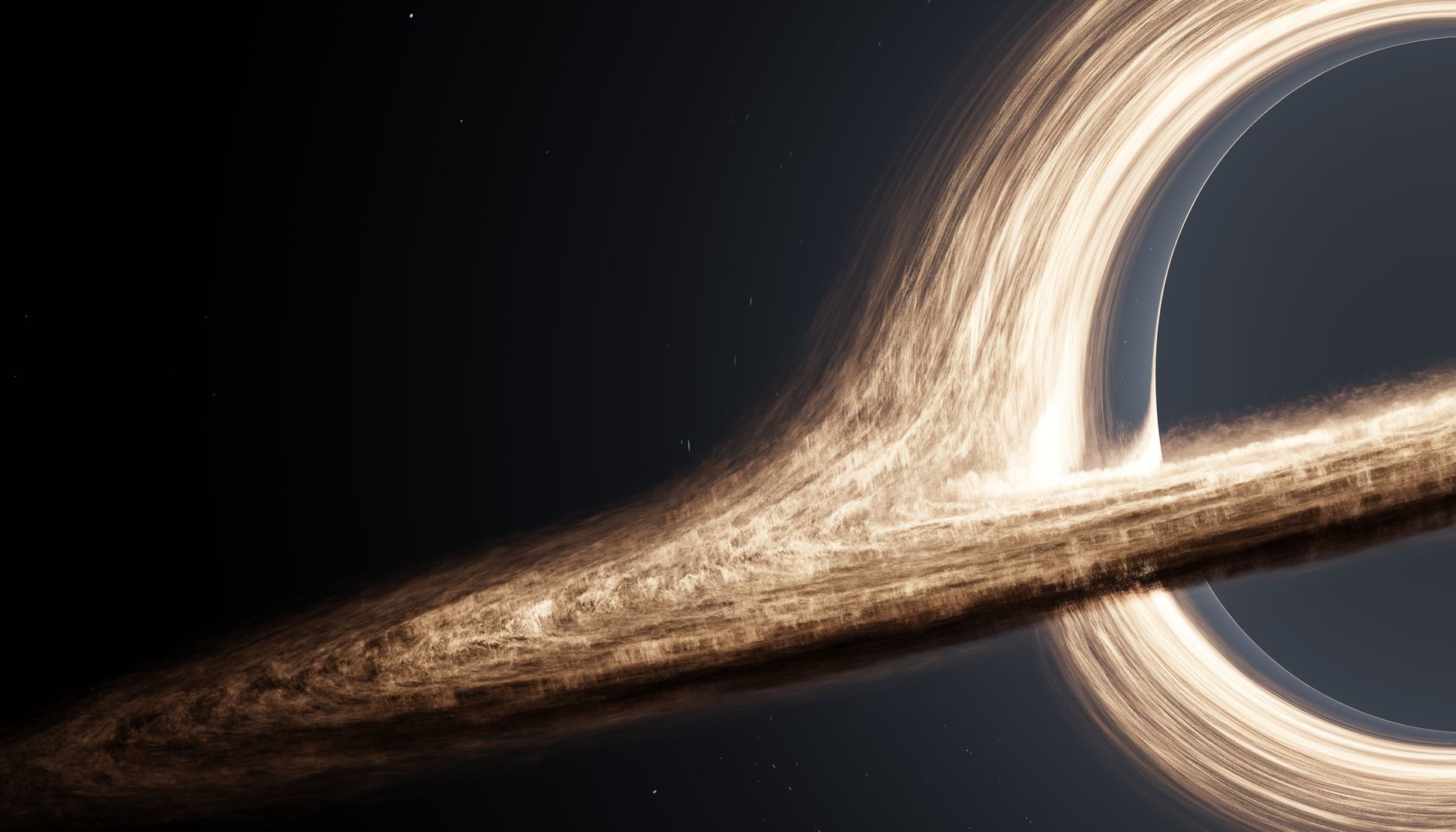
In a remarkable fusion of technology and astronomy, scientists have harnessed artificial intelligence to create a captivating video of a supermassive black hole jet. The animation, released by a team of astrophysicists at Caltech, reveals the blazar 3C 345 in the constellation Hercules, showcasing the jet's plasma in the highest resolution achieved to date.
This state-of-the-art video is not merely a visual delight but a scientific breakthrough. Traditionally, astronomers have relied on isolated snapshots to study these cosmic phenomena, often leaving gaps in their understanding. By employing AI, researchers filled in these visual gaps, sharpening the clarity of the images by an impressive factor of four. For the first time, scientists can continuously track the plasma's movement, offering a dynamic view rather than a series of disjointed stills.
The significance of this development extends beyond the aesthetic. Black holes, with their intense gravitational forces, remain among the most enigmatic entities in the universe. The ability to observe the movement within a black hole jet in such detail provides invaluable insights into the behaviour of these celestial giants. It also paves the way for future exploration and potential discoveries about other cosmic phenomena.
AI: A New Tool in Astronomy
The application of AI in astronomy is proving transformative. By converting radio telescope data into high-resolution videos, AI has unveiled motions within the black hole jet that were hitherto unseen. These advancements allow astronomers to compare traditional observation methods, like the CLEAN method, with modern AI-driven techniques, showcasing the latter's superior capabilities.
While the video of 3C 345 is a singular achievement, it also signifies a broader shift in how we study the universe. With AI, astronomers can now delve deeper into the mysteries of space, potentially unveiling secrets hidden in the vast expanse of the cosmos.
As we stand on the brink of a new era in astronomical research, one thing becomes clear: the cosmos, in all its complexity, is becoming just a little bit more comprehensible.